Aller au contenu principal

What Is an Aluminum Motor Housing and Why Is It Used?

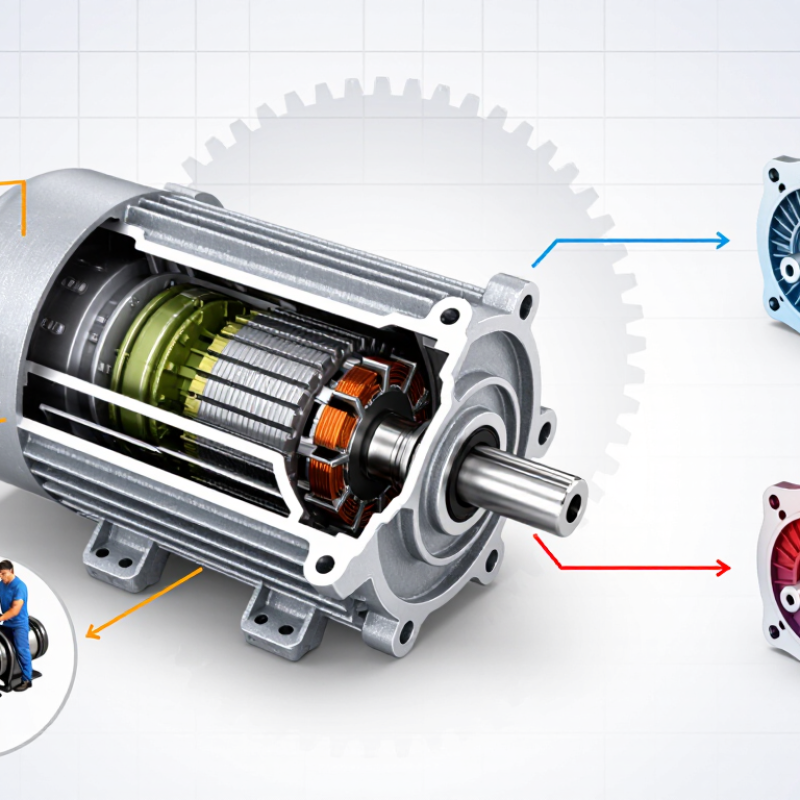
An aluminum motor housing is the protective outer shell surrounding an electric motor’s stator, rotor, and internal electrical components. It supports alignment, controls vibration, and helps transfer heat away from the windings. The choice matters because motor-driven systems consume a substantial share of global electricity. The International Energy Agency reports that electric motors and related systems use more than 40% of global electricity. Even small efficiency losses can therefore create measurable operating costs.

Aluminum is widely selected because it combines low weight, corrosion resistance, and useful thermal conductivity. The International Aluminium Institute identifies aluminum’s density as approximately one-third that of steel, supporting lighter motor designs and easier handling. The U.S. Department of Energy’s Motor Systems Market Assessment also emphasizes that improved motor-system performance can reduce industrial energy consumption. A lighter housing may simplify installation, especially when technicians lift motors onto conveyors, pumps, or compact machinery.

But aluminum is not automatically the best choice. Steel housings can offer greater stiffness, impact resistance, or dimensional stability in demanding environments. Design results depend on wall thickness, casting quality, surface treatment, cooling paths, and bearing alignment. The IEC 60034 series provides widely used requirements for rotating electrical machines, yet compliance does not eliminate every application risk. Engineers still need to verify temperature rise, ingress protection, vibration, and fatigue performance.

This article explains what an aluminum motor housing does, why manufacturers use it, and where its limits appear. The evidence is useful, but not absolute. Actual performance depends on the complete motor system, not the housing alone.
What Is an Aluminum Motor Housing and Why Is It Used?

What Is an Aluminum Motor Housing?

An aluminum motor housing is the protective outer body surrounding an electric motor’s internal parts. It supports the stator, shields windings, and provides mounting points for installation. Manufacturers commonly produce it through die casting, extrusion, or precision machining. Each method affects strength, size, surface finish, and production cost.

Aluminum is widely used because it combines low weight with useful mechanical strength. A technician can lift a medium motor more easily during installation or maintenance. The metal also transfers heat away from the motor core. Fins, vents, or contact with a machine frame can improve this effect. However, aluminum alone does not guarantee cool operation. Poor airflow, undersized fins, or excessive load can still create dangerous heat.

In practical inspections, I look for cracks near mounting holes, damaged threads, and uneven surfaces. These small defects can cause vibration or misalignment. A sealed housing may also resist dust and moisture, but its protection depends on gaskets, covers, and assembly quality.

The aluminum body is only one part of that system. It can corrode in harsh environments, especially when salt or incompatible metals are present. A thicker housing is not automatically better, either. It may add durability, but it can increase weight and restrict heat release. This trade-off deserves careful review for each motor application.

How Aluminum Motor Housings Are Designed and Manufactured

What Is an Aluminum Motor Housing and Why Is It Used?

An aluminum motor housing supports the motor’s internal parts and helps control operating temperature. Designers usually begin with the motor’s torque, speed, load, and installation environment. Wall thickness must resist vibration without adding unnecessary weight. External fins may increase cooling, while internal ribs can improve stiffness. Yet, more ribs are not always better. They can restrict airflow and complicate casting.

How Aluminum Motor Housings Are Designed and Manufactured

Engineers often use die casting for high-volume production, especially when complex shapes and repeatable dimensions are required. The mold must allow smooth metal flow and easy part removal. Poor flow can create porosity, which may weaken mounting areas or reduce sealing performance. After casting, selected surfaces may receive CNC machining for bearing seats, bolt holes, and alignment faces. These areas need controlled tolerances. Small errors can cause noise, heat, or premature wear. Surface treatment may improve corrosion resistance, but it cannot correct a poorly designed joint. Inspection should include dimensional checks, visual examination, and leak testing when the housing protects enclosed components.

Tips

Keep bearing seats and mounting faces in one machining setup when possible. This improves alignment. Provide drainage paths for moisture. Avoid sharp internal corners; they increase stress and may slow material flow. A design review should question weight reductions, because thinner walls can create distortion after cooling. Sometimes, stronger is safer. Sometimes, it is simply heavier.

Key Properties of Aluminum in Motor Housing Applications

What Is an Aluminum Motor Housing and Why Is It Used?

An aluminum motor housing encloses and protects the motor’s stator, rotor, bearings, and electrical connections. Its main advantage is low mass. Aluminum has a density near 2.70 g/cm³, about one-third that of steel, according to ASM International’s engineering data. This reduction helps technicians lift, install, and service motors more easily. It also supports compact equipment designs.

Heat management matters. Aluminum alloys commonly provide thermal conductivity between 120 and 170 W/m·K, depending on their composition and treatment. Steel usually transfers heat much more slowly. A housing with external fins can spread heat from the windings into surrounding air. The U.S. Department of Energy identifies motor efficiency and heat control as important factors in motor-system performance. Still, housing material alone cannot prevent overheating. Poor airflow, undersized fins, or overloaded bearings can defeat good design.

Aluminum also resists atmospheric corrosion and works well with die casting. Complex ribs, mounting feet, and cable-entry features can be formed in one part. The U.S. Geological Survey’s Mineral Commodity Summaries 2025 reports that recycled aluminum production uses roughly 5% of the energy required for primary aluminum. That supports circular manufacturing, although recycling quality depends on alloy separation and contamination control. Aluminum has weaknesses. It expands more than steel, can lose strength at elevated temperatures, and may create galvanic corrosion when contacting dissimilar metals. Engineers must use suitable coatings, fasteners, and clearances. The material is useful, not perfect.

What Is an Aluminum Motor Housing and Why Is It Used?

Key Properties of Aluminum in Motor Housing Applications

The chart compares the estimated mass of a 1-liter motor housing made from representative materials. Aluminum 6061-T6 has a density of approximately 2.70 kg/L, making it about 66% lighter than low-carbon steel and about 62% lighter than cast iron. This low mass helps reduce motor weight and improves installation efficiency.

Aluminum also provides good heat dissipation, with thermal conductivity of approximately 167 W/m·K for 6061-T6, while its naturally forming oxide layer offers useful corrosion resistance. These properties make aluminum a practical choice for motor housings that require low weight, structural rigidity, and effective heat transfer.

Why Aluminum Motor Housings Are Used in Electric Motors

What Is an Aluminum Motor Housing and Why Is It Used?

An aluminum motor housing surrounds and protects the motor’s internal components. In electric motors, it supports the stator, bearings, mounting points, and cooling structure. Aluminum is lightweight, so technicians can handle and install the motor more easily. This benefit matters in pumps, fans, conveyors, and compact machines. Aluminum also transfers heat efficiently. Heat can move from the stator toward the outer surface and cooling fins. That thermal path matters. Lower operating temperatures may support insulation life and stable motor performance.

Manufacturers often select aluminum because it can be cast into detailed shapes. Ribs, mounting feet, cable-entry areas, and fan covers can form as one integrated housing. Compared with steel, aluminum also offers useful resistance to many outdoor conditions. Castings can be complex. However, aluminum is softer and expands more with temperature changes. A poorly controlled fit may affect bearing alignment. In workshop practice, small casting variations can become noticeable during assembly. This trade-off is easy to underestimate.

Reliable aluminum housings require careful engineering and inspection. Technicians check wall thickness, flatness, thread quality, and bearing-seat dimensions. Vibration testing can reveal weak ribs or loose mounting areas. Thermal cycling also shows whether joints remain stable after repeated heating and cooling. Electrical grounding needs attention because paint, oxidation, or loose contact can interrupt the protective path. Small details decide performance. Engineers may add steel inserts where threads face repeated tightening. The best housing design depends on load, temperature, environment, and manufacturing accuracy.

Common Applications and Selection Considerations for Aluminum Motor Housings

An aluminum motor housing encloses the stator, rotor, bearings, and electrical connections. Its main advantage is a strong strength-to-weight ratio. Aluminum also transfers heat efficiently from windings to the surrounding air. That matters because excess heat shortens insulation life. The U.S. Department of Energy reports that motor-driven equipment consumes more than half of industrial electricity. Better thermal control can support reliable operation, although housing design alone cannot improve a poorly selected motor.

Common applications include conveyor systems, pumps, fans, compressors, packaging equipment, and small electric vehicles. Aluminum housings are useful where frequent handling, corrosion resistance, and lower equipment weight matter. They also suit outdoor machinery when paired with suitable coatings and sealed joints. In practice, inspect the mounting feet, cable entry, and drain points. Small gaps can invite moisture.

Selection requires more than comparing weight. Check the motor’s power, speed, duty cycle, ambient temperature, and installation position. Confirm the enclosure rating for dust and water exposure. A 2023 International Energy Agency analysis highlights the continuing importance of efficient motor systems in industrial energy use. Material sustainability also deserves attention. The International Aluminium Institute states that recycled aluminum requires about 5% of the energy used for primary aluminum production. Still, recycled content may affect availability and consistency. That is easy to overlook. Engineers should verify thermal expansion, vibration resistance, bearing alignment, and repair access before approval. A lighter housing is not always the better housing.

What Is an Aluminum Motor Housing and Why Is It Used? - Common Applications and Selection Considerations for Aluminum Motor Housings
Selection Dimension Typical Data or Option Why It Matters Common Applications Practical Selection Considerations
Basic Function Protective structural enclosure for the stator, rotor, bearings, and internal electrical components Maintains alignment, provides mechanical protection, and helps transfer heat away from the motor core. AC induction motors, permanent-magnet motors, brushless DC motors, servo motors, and fan motors Check the required mounting geometry, bearing-seat accuracy, shaft alignment, enclosure rating, and access provisions for assembly and maintenance.
Typical Material Aluminum alloys used for die casting, gravity casting, sand casting, or machining Aluminum offers low mass, corrosion resistance, good thermal conductivity, and efficient manufacturability. Portable equipment, HVAC systems, pumps, conveyors, automation equipment, and vehicle auxiliary systems Select the alloy and process according to wall thickness, dimensional tolerance, pressure-tightness, surface finish, production volume, and cost targets.
Density Approximately 2.6–2.8 g/cm³ for common aluminum alloys Aluminum is approximately one-third the density of steel, reducing housing mass and handling effort. Mobile machinery, compact drives, robotic equipment, battery-powered systems, and airborne or transport-related equipment Compare total assembly weight rather than housing weight alone; include fins, mounting feet, end shields, fasteners, and any protective coating.
Thermal Conductivity Common cast aluminum alloys: approximately 90–170 W/m·K; wrought alloys may be higher Higher conductivity helps spread heat from the stator and windings to the outer surface. Continuous-duty motors, fan-cooled motors, pumps, compressors, and motors operating in warm environments Evaluate the complete thermal path, including contact between the stator and housing, cooling fins, airflow, ambient temperature, and allowable winding temperature.
Mechanical Strength Typical ultimate tensile strength range: approximately 150–330 MPa, depending on alloy and temper Strength supports bearing loads, mounting forces, vibration, and impact resistance. Gearmotors, industrial drives, pump motors, machine tools, and equipment exposed to moderate vibration Use local reinforcement around bearing seats and mounting holes where necessary. Verify fatigue, shock, and vibration requirements instead of relying only on tensile strength.
Manufacturing Process Die casting for high-volume complex shapes; gravity or sand casting for larger or lower-volume parts; machining for precision features The process affects achievable wall thickness, porosity, dimensional accuracy, tooling cost, and production speed. High-volume motor frames, prototype housings, custom industrial motors, and large motor enclosures Die casting is suitable for repeatable production and integrated ribs. Machining may be required for bearing bores, sealing faces, threaded holes, and close-tolerance interfaces.
Corrosion Resistance Generally good in normal atmospheric conditions; improved further with anodizing, powder coating, or painting Helps extend service life and preserve appearance in humid or mildly corrosive environments. Outdoor equipment, ventilation systems, marine-adjacent machinery, food-processing support equipment, and clean industrial areas Consider salt spray, chemicals, galvanic contact with steel or copper, drainage design, coating compatibility, and required ingress protection.
Dimensional Stability Coefficient of thermal expansion: approximately 21–24 × 10⁻⁶/K for common aluminum alloys Aluminum expands more with temperature than steel, which can affect bearing preload, alignment, and sealing. Precision drives, servo motors, high-speed motors, and equipment with large temperature changes Allow for operating-temperature changes in bearing fits, shaft alignment, end-shield interfaces, and connections between aluminum and steel components.
Acoustic and Vibration Behavior Low mass with moderate structural stiffness; ribs and optimized wall geometry are commonly used Housing geometry influences resonance, vibration transmission, and operating noise. Fans, pumps, office equipment, household appliances, and automated production equipment Use ribs, mounting isolators, balanced rotating parts, and suitable wall thickness. Validate the design through vibration and noise testing at operating speed.
Enclosure Protection Common design targets include open, drip-resistant, or sealed enclosures; the final rating depends on the complete motor assembly Protection against dust, water, and accidental contact is determined by the housing, seals, cable entries, covers, and ventilation design together. Indoor motors, outdoor motors, washdown-adjacent equipment, pumps, and industrial automation systems Specify the required ingress-protection level, gasket material, drainage, venting, connector sealing, and test method before finalizing the housing.
Surface Treatment As-cast finish, machining, anodizing, powder coating, liquid painting, or conversion coating Surface treatment can improve corrosion resistance, wear resistance, appearance, and electrical isolation. Consumer products, outdoor equipment, industrial machinery, and applications requiring a specified appearance Confirm coating thickness, masking areas, grounding requirements, dimensional allowance, adhesion, and compatibility with operating temperature and chemicals.
Weight and Cost Balance Low weight with moderate material and tooling cost; production economics depend strongly on quantity and process Aluminum can reduce transportation, installation, and structural-support requirements while supporting efficient mass production. Portable drives, distributed motor systems, compact machinery, and high-volume electrical equipment Compare tooling, machining, finishing, scrap, inspection, assembly, and lifecycle costs rather than evaluating raw material price alone.
Key Validation Tests Dimensional inspection, thermal testing, vibration testing, leakage testing where applicable, corrosion evaluation, and endurance testing Testing confirms that the housing performs under actual loads, temperatures, environments, and assembly conditions. Safety-critical drives, continuous-duty motors, outdoor equipment, high-speed motors, and customized motor assemblies Define acceptance criteria for temperature rise, bearing alignment, vibration, noise, sealing, coating adhesion, mechanical strength, and service life.
Note: Material properties are typical approximate ranges for commonly used aluminum alloys and can vary with alloy designation, temper, casting method, heat treatment, wall thickness, and test conditions. Final motor-housing selection should be verified against the applicable mechanical, thermal, electrical, environmental, and safety requirements.